Category Archives: Greenwashing

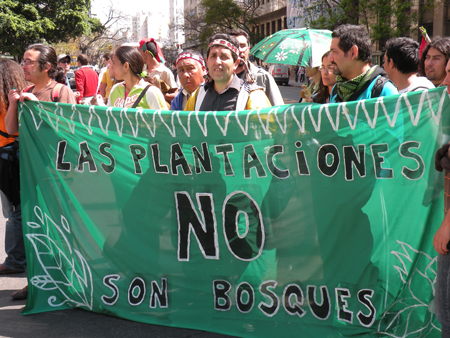
Memo to WWF: Destroying rainforests and peatland for palm oil is not “sustainable”

By Chris Lang, May 14, 2013. Source: redd-monitor

Image: Banksy

Image: Banksy

WWF loves “sustainability”. With “sustainability”, there’s no need to address over-consumption, or the never-ending growth of capitalist expansion. Consumption can increase, as long as it’s “sustainable”.

Palm oil plantations destroying vast areas of rainforest? No problem. Here comes “sustainable” palm oil. In 2001, WWF started discussions with palm oil companies and industry bodies. Three years later the Roundtable on Sustainable Palm Oil was formed.

Today there are more than 500 members of the RSPO, including palm oil producers, processors, traders, retailers, banks and a few NGOs. But buying palm oil from RSPO members does not mean that the palm oil complies to RSPO’s standards. For that you need to buy RSPO-certified palm oil – from companies that have been assessed by an RSPO-approved certification body. But RSPO certification does not mean that companies have stopped clearing forests. TFT’s Scott Poynton pointed this out recently to Jason Clay, Senior Vice President, Markets, World Wildlife Fund US:

Deforestation of secondary yet still important forests is perfectly acceptable and is happily done by companies celebrated under the RSPO standard which only obliges protection of primary and HCVF [high conservation value forest] areas. Likewise, the RSPO standard doesn’t preclude the clearance of peatlands.

Continue reading

2 Comments

Filed under Biodiversity, Bioenergy / Agrofuels, Ending the Era of Extreme Energy, False Solutions to Climate Change, Forests, Forests and Climate Change, Greenwashing, REDD

Protecting carbon to destroy forests: Land enclosures and REDD+

By Chris Lang, May 6, 2013. Source: redd-monitor

2013-05-06-144632_249x259_scrotA new report by Carbon Trade Watch takes a detailed and critical look at REDD from the perspective of land enclosures. “REDD+ will not stop deforestation,” the report argues. Rather than addressing the root causes of deforestation, REDD promotes the argument that environmental destruction in one location can be ‘compensated’ in another. As such, REDD reinforces underlying causes of deforestation.

The report, titled “Protecting carbon to destroy forests: Land enclosures and REDD+”, can be downloaded here (pdf file, 1.3 MB). The report is edited by Transnational InstituteFDCL and FIAN.

The report points out that rather than putting pressure on corporations to clean up their acts or support local struggles, REDD,

gives forest destroyers a way to legitimize their actions as environmentally ‘friendly’ or ‘carbon neutral’. Far from positioning itself as an ally to the many local groups that have preserved forested lands most strongly, REDD+ tends to silence debates about the unjust realities surrounding corporate pressures on land tenure regimes.

Continue reading

1 Comment

Filed under Biodiversity, Bioenergy / Agrofuels, Carbon Trading, Corporate Globalization, False Solutions to Climate Change, Forests, Forests and Climate Change, Greenwashing, Indigenous Peoples, Industrial agriculture, Land Grabs, Latin America-Caribbean, REDD

G8′s biofuel use contributing to world hunger: new report

29 April 2013.  Source: Action Aid International

Amount of food crops burnt by richest nations as biofuels could feed half the world’s hungriest people, ActionAid says

Half the world’s hungry – 441 million people – could eat for a year on the amount of food that G8 countries burn in their petrol tanks as biofuels, ActionAid said today.

New data, published today by the anti-poverty agency, reveals that nearly nine billion litres of biofuels are used annually to fuel cars in the world’s wealthiest countries. This equates to the yearly amount of food needed to feed half of the world’s 870 million people who live in hunger.

The report also highlights that six million hectares of land in sub-Saharan Africa (equivalent to almost half the area of England ) have been taken over by European companies to grow biofuel crops. UK companies account for a disproportionately high amount – one-third – of that land (two million hectares).

Anders Dahlbeck, Policy Adviser at ActionAidUK, said: “Can we really justify using food to fuel our cars while one in eight people are going hungry?

“If the world’s most powerful nations are serious about tackling world hunger, they must first address their own biofuel use. Their policies have created a demand for the worst kinds of biofuels that push up food prices and are produced from crops that grow on land which should be used for food.”

ActionAid’s database of European biofuel company activities in Africa confirms the significant impact European biofuel policies are having on the distribution of land and land rights in developing countries. With 98 documented biofuel projects covering 6 million hectares, the biggest investors of biofuels in Sub-Saharan Africa are from the UK (30 projects), Italy (18) and Germany (8) – and the total number of European biofuel projects (including Norway and Switzerland) is 98.

Dahlbeck continued: “The G8 meets in the UK later this summer. David Cameron has committed to put the causes of global hunger high on the political agenda during his presidency. This is an important opportunity for him to show leadership and urge other countries to acknowledge and address the impact that biofuels have on hunger.”

Official policies around the world have created enormous demand for biofuels because it was hoped they would be ‘greener’ than burning fossil fuels. But as well as being discredited environmentally, biofuels have become a major driver of world hunger as crops are diverted away from food production to produce fuel. As massive tracts of land are acquired or grabbed to grow biofuel crops instead of food, families are left without land to feed themselves or to grow crops to sell and support themselves.

Dahlbeck added: “What may originally have been a well-intentioned policy to make our transport fuels greener has turned out to be disastrous for global hunger. It has led to the diversion of land use and, in a further irony, may be worsening global warming as many biofuels increase greenhouse gas emissions.”

ActionAid’s Food not Fuel week takes place from Monday 29th April – Sunday 5th May to highlight the absurdity of using food as fuel. ActionAid is a member of the Enough Food IF campaign, a coalition of more than 100 charities which, in the year that the UK hosts June’s summit of G8 nations, are joining ActionAid in calling for David Cameron to take a lead on this issue.

>> Download ActionAid’s report: Fuelling Hunger

Leave a Comment

Filed under Biodiversity, Bioenergy / Agrofuels, False Solutions to Climate Change, Food Sovereignty, Green Economy, Greenwashing, Industrial agriculture, Land Grabs, Water

Concerns grow over weak safeguard implementation in REDD

Forest Peoples Programme on REDD and safeguards

By Chris Lang, May 1st 2013.  Source: REDD-Monitor
Forest Peoples Programme’s April 2013 E-Newsletter focuses on safeguards. The E-Newsletter starts by looking at why safeguards matter. Other articles explain and comment on the World Bank’s safeguards review, forest policy and oil palm policy, the failure of safeguards in the Camisea gas project in Peru and examples from the Congo Basin and Cameroon.

An article by Francesco Martone and Tom Griffiths gives a critical overview of safeguards in REDD. The article looks at how the safeguards included in the 2010 decision on REDD at the UNFCCC COP16 meeting in Cancun have been adapted and watered down in key REDD programmes:

While on paper the translation of the UNFCCC political mandate on safeguards seems to have led to some significant achievements in terms of recognition of indigenous peoples’ rights, when it comes to operationalisation and implementation the picture is so far less encouraging.

Continue reading

Leave a Comment

Filed under Biodiversity, Carbon Trading, Climate Justice, False Solutions to Climate Change, Forests, Forests and Climate Change, Greenwashing, Indigenous Peoples, Land Grabs, Latin America-Caribbean, Pollution, REDD, Rights, Resilience, and Restoration

Federation of small farmers in Peru attacks REDD: “No REDD projects! No carbon trading!”

By Chris Lang, April 26, 2013. Source: redd-monitor

2013-04-26-113053_897x760_scrotOn 19 April 2013, the Federation of small farmers of Madre de Dios in Peru (Federación Agraria Departmental de Madre de Dios – FADEMAD) produced a statement titled “The threats over us continue”. The statement raises serious concerns about REDD and related initiatives that are developing in the region.

The lowland Amazon forests of Madre de Dios in south-east Peru are amongst the most biodiverse in the world. But REDD schemes to preserve the forests of Madre de Dios and Peru are coming under increasing criticism. In February 2013, AIDESEP (Inter-Ethnic Association for the Development of the Peruvian Amazon) wrote to the Forest Investment Programme warning that REDD in Peru “will lead to an increase in emissions from deforestation”.

Also in February 2013, the Federation for Native Communities of Madre de Dios (FENAMAD)released a statement demanding greater accountability in forest and climate projects in Peru, including the Forest Investment Programme.

A draft copy of the Forest Investment Programme (FIP) Plan for Peru, dated 15 March 2013, is available here in Spanish (pdf file, 2.5 MB). The FIP in Peru is funded by the World Bank and the Inter-American Development Bank. The draft of the FIP Plan focusses on the Peruvian Amazon and aims to address the causes of deforestation, improving forest governance and involving civil society and the private sector. The draft describes REDD as “a very promising tool to support the efforts of the country in this process of change, fundamental to face deforestation and forest degradation”.
Continue reading

Leave a Comment

Filed under Actions / Protest, Carbon Trading, False Solutions to Climate Change, Food Sovereignty, Forests and Climate Change, Greenwashing, Latin America-Caribbean, REDD

Groups globally oppose plans to burn wood for electricity, citing impacts on forests, climate, communities

Note: Join Global Justice Ecology Project, the Dogwood Alliance, Earth First! and the STOP Genetically Engineered Trees Campaign from May 26-June 1st in Asheville, NC as we tell the GE trees industry NO WAY to plantation of GE trees for biofuels.  Visit: treebiotech2013.org  and view the call to action here.

-The GJEP Team

April 24, 2013. Source: Global Justice Ecology Project

resize.phpIn conjunction with an action in London today outside of the Drax power plant, organisations and networks from around the world released an Open Letter expressing opposition to plans by UK utility Drax to burn nearly 16 million tonnes of mostly imported biomass (wood), in a coal power station.

Drax is one of several European companies converting older power stations from burning coal to burning wood pellets or pellets combined with coal (“cofiring”). US and Canadian energy companies are also investing in biomass power stations and co-firing of coal with wood. This trend, supported by renewable energy policies, is establishing massive new demand and international trade in wood pellets, and represents a huge additional threat to forests, biodiversity, climate and communities.

Lacking forest resources to meet their own demand, European energy companies like Drax seek to import pellets especially from the southeastern US and British Columbia, Canada. In the longer term, they plan to invest in pellets made from industrial tree plantations in South America and/or Africa.
Continue reading

1 Comment

Filed under Actions / Protest, Africa, Bioenergy / Agrofuels, BREAKING NEWS, Climate Change, Coal, Ending the Era of Extreme Energy, False Solutions to Climate Change, Forests and Climate Change, GE Trees, Genetic Engineering, Greenwashing, Land Grabs, Latin America-Caribbean

The EU Emissions Trading Scheme has failed: “Time to scrap the ETS”

By Chris Lang, April 16 2013. Source: REDD-Monitor

2013-04-16-133149_932x995_scrot“No amount of structural tinkering will get away from the fact that the EU has chosen the wrong tool to reduce emissions in Europe. It is inherently too weak to get the EU to where it needs to be in the necessary timescale,” says Hannah Mowat from FERN. “The EU can no longer wait for the market to deliver.”

Mowat’s comment comes on the release of a report exposing the Myths of EU Emissions Trading Scheme. A press release about the report is posted below, and the report, “EU ETS myth busting: Why it can’t be reformed and shouldn’t be replicated”, can be downloaded here (pdf file, 1.3 MB). The report is published by several of the organisations that signed on to the “Time to scrap the ETS”declaration. So far, more than 130 organisations have signed the declaration – if your organisation wants to sign on, please send an email to scrap.the.ets@gmail.com.

Meanwhile, Climaxi is holding a Greenwash Circus in Gent on 20 April 2013. The EU ETS is currently in first place (by five votes). Place your vote here.

In February 2013, the European Parliament’s Environment Committee voted in favour of postponing (or backloading) the auctioning of 900 million pollution allowances. The allowances will be auctioned instead in 2019-2020. Although the aim of the proposal is to increase the price of carbon in the ETS, the market’s reaction to the February vote was a 20% slump in the price of EU allowances. Today, the European Parliament in Strasbourg will vote on whether the backloading proposal should be implemented. Continue reading

Leave a Comment

Filed under Carbon Trading, Climate Change, Climate Justice, Commodification of Life, Ending the Era of Extreme Energy, Energy, False Solutions to Climate Change, Green Economy, Greenwashing, Pollution, The Greed Economy and the Future of Forests

A dam too far in Laos

By Melinda Boh, April 12 2013. Source: Asia Times

World Bank-backed Nam Theun 2 mega-dam in Laos under construction in 2009.  Photo: Top News

World Bank-backed Nam Theun 2 mega-dam in Laos under construction in 2009. Photo: Top News

VIENTIANE – It was once referred to by US magazine Newsweek as a “kinder, gentler” type of dam. Since the Nam Theun 2 hydropower dam commenced commercial operations in 2010, the World Bank and other proponents of the multi-billion dollar power project have trumpeted it as an economic and social development success story for host country Laos.

But with the negative publicity and diplomatic tussles now focused on the proposed US$3.5 billion Xayaboury dam, which if built promises to hurt downstream communities and the environment in Cambodia, Laos and Vietnam, Nam Theun 2′s emerging failures have largely escaped critical scrutiny.

In particular, there are rising indications that Nam Theun 2 and its 450 square kilometer reservoir are responsible for massive amounts of greenhouse gas (GHG) emissions, amounting to as much as one million tons of methane and carbon dioxide per year, according to recent independent academic studies, including a statistical assessment produced by the US’s Duke University.

If accurate, that figure is substantially higher than the level of emissions initially estimated in the project’s environmental impact assessment. Researchers from Toulouse University in France have concluded that Nam Theun 2 produces in excess of 40% of the GHG that would be emitted from a coal fired power plant of equivalent energy output, and far more than a natural gas-fired plant.  Continue reading

1 Comment

Filed under Climate Change, Ending the Era of Extreme Energy, Energy, False Solutions to Climate Change, Forests, Green Economy, Greenwashing, Hydroelectric dams, The Greed Economy and the Future of Forests, Water, World Bank

Power shift away from green illusions

By Steve Horn, April 8 2013. Source: TruthOut

Photo: twicepix

Photo: twicepix

Every day, the news about climate change and the harms that are sure to accompany it gets worse and worse. To many environmentalists, the answer is simple:power shift. That is, shift from fossil fuels to clean, green, renewable, alternative energy. Well-meaning concerned citizens and activists have jumped on the bandwagon.

The problem with this simple solution: Things aren’t as simple as they seem, and “there’s actually no such thing as a free lunch” when it comes to energy consumption and production. Further, what we’re often sold as “green” and “clean” is actually neither. In the spirit of these inconvenient truths came a timely and provocative book, perhaps missed by many, titled, “Green Illusions: The Dirty Secrets of Clean Energy and the Future of Environmentalism,” by Ozzie Zehner.

As Zehner writes in the book’s opening pages, “…this certainly isn’t a book for alternative energy. Neither is it a book against it. In fact, we won’t be talking in simplistic terms of for or against, left and right, good and evil … Ultimately, this is a book of shades.” The book does show some of the “shady” sides of the clean energy hype and in so doing, dampens the hype around it.

Having recently read the book myself, I decided to contact Ozzie and ask him follow-up questions. Below is a transcript of our email conversation, which unfolded over the past few months. Continue reading

1 Comment

Filed under Climate Change, Ending the Era of Extreme Energy, Energy, False Solutions to Climate Change, Green Economy, Greenwashing

The fuel of the future: Environmental lunacy in Europe

Note: As Global Justice Ecology Project and its allies have been saying for years, burning trees to produce electricity is NOT carbon neutral.  Biomass is not the silver bullet many once thought it was, and the EU’s new push toward biomass power will have devastating impacts on forests and the climate.  Join GJEP allies Biofuelwatch on April 24 as they take DRAXtic Action to say no to biomass and coal in London and around the world.

April 6, 2013. Source: The Economist

Drax biomass plant in Selby being built (Steve Walsh)

Drax biomass plant in Selby being built (Steve Walsh)

Which source of renewable energy is most important to the European Union? Solar power, perhaps? (Europe has three-quarters of the world’s total installed capacity of solar photovoltaic energy.) Or wind? (Germany trebled its wind-power capacity in the past decade.) The answer is neither. By far the largest so-called renewable fuel used in Europe is wood.

In its various forms, from sticks to pellets to sawdust, wood (or to use its fashionable name, biomass) accounts for about half of Europe’s renewable-energy consumption. In some countries, such as Poland and Finland, wood meets more than 80% of renewable-energy demand. Even in Germany, home of the Energiewende (energy transformation) which has poured huge subsidies into wind and solar power, 38% of non-fossil fuel consumption comes from the stuff. After years in which European governments have boasted about their high-tech, low-carbon energy revolution, the main beneficiary seems to be the favoured fuel of pre-industrial societies.

The idea that wood is low in carbon sounds bizarre. But the original argument for including it in the EU’s list of renewable-energy supplies was respectable. If wood used in a power station comes from properly managed forests, then the carbon that billows out of the chimney can be offset by the carbon that is captured and stored in newly planted trees. Wood can be carbon-neutral. Whether it actually turns out to be is a different matter. But once the decision had been taken to call it a renewable, its usage soared.

In the electricity sector, wood has various advantages. Planting fields of windmills is expensive but power stations can be adapted to burn a mixture of 90% coal and 10% wood (called co-firing) with little new investment. Unlike new solar or wind farms, power stations are already linked to the grid. Moreover, wood energy is not intermittent as is that produced from the sun and the wind: it does not require backup power at night, or on calm days. And because wood can be used in coal-fired power stations that might otherwise have been shut down under new environmental standards, it is extremely popular with power companies.
Continue reading

2 Comments

Filed under Bioenergy / Agrofuels, Climate Change, Ending the Era of Extreme Energy, False Solutions to Climate Change, Forests and Climate Change, Greenwashing