Category Archives: Genetic Engineering

GMOs: Fooling – er, “feeding” – the world for 20 years

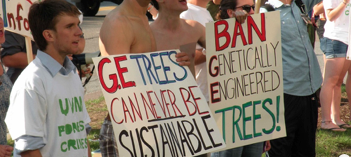
Note: Stand up for Native Forests!  Stop Genetically Engineered Trees!

In addition to controlling the world’s food supply, the evildoers in the biotech industry intend on planting billions of Genetically Engineered trees across the US South and internationally in toxic monoculture plantations.  And they’re meeting this month in Asheville, NC.

Join Global Justice Ecology Project, the Campaign to STOP GE Trees, Earth First!, and others in Asheville from May 26-June 1, for a week of action to confront ArborGen, FuturaGene and other tree biotech evildoers.  Join the protests or donate to support an activist here:www.treebiotech2013.org

-The GJEP Team

May 15 2013. Source: GRAIN

Defending seeds and biodiversity.  No to GMOs.  Photo: GRAIN

Defending seeds and biodiversity. No to GMOs. Photo: GRAIN

Myths and outright lies about the alleged benefits of genetically engineered crops (GE crops or GMOs) persist only because the multinationals that profit from them have put so much effort into spreading them around.

They want you to believe that GMOs will feed the world; that they are more productive; that they will eliminate the use of agrichemicals; that they can coexist with other crops, and that they are perfectly safe for humans and the environment.

False in every case, and in this article we’ll show how easy it is to debunk these myths. All it takes is a dispassionate, objective look at twenty years of commercial GE planting and the research that supposedly backs it up. The conclusion is clear: GMOs are part of the problem, not part of the solution.

An article by GRAIN, published in Soberania Alimentaria, numero 13.

MYTH: GE crops will end world hunger. Continue reading

Leave a Comment

Filed under Biodiversity, Climate Change, Commodification of Life, Corporate Globalization, Food Sovereignty, Genetic Engineering, Industrial agriculture

Biotech ambassadors: Diplomacy or marketing?

Note: While some biotech firms are scrambling for control over the world’s food supply, others have their greedy eyes on the world’s forestlands.  ArborGen, with its revolving doors between Monsanto and the US government, has plans to plant billions of highly flammable and invasive Genetically Engineered eucalyptus trees across the US South in monoculture plantations – with other native species like poplar and pine close behind in the regulatory pipeline.  Along with industry rival FuturaGene, these GE tree companies intend to move forward across the global south; from Brazil to South Africa, China, Indonesia, New Zealand, and Australia.

But we can stop them in their tracks here in the US.  From May 26th to June 1st, activists are descending upon Asheville, NC for a week of action to confront a major Tree Biotechnology conference sponsored by ArborGen and other firms.  Join the protests or donate to support an activist here: www.treebiotech2013.org

-The GJEP Team

May 14 2013. Source: Food and Water Watch

Today Food & Water Watch and its European project Food & Water Europe released the first comprehensive analysis of the U.S. government’s strategy, tactics and foreign policy objectives to promote pro-agricultural biotechnology policies worldwide. Biotech Ambassadors: How the U.S. State Department Promotes the Seed Industry’s Global Agenda examines more than 900 State Department diplomatic cables from 2005 to 2009 and details how the U.S. State Department lobbies foreign governments to adopt pro-agricultural biotechnology policies and laws, operates a rigorous public relations campaign to improve the image of biotechnology and challenges commonsense biotechnology safeguards and rules — including opposing genetically engineered (GE) food labeling laws.

“The U.S. Department of State is selling seeds instead of democracy,” said Wenonah Hauter, executive director of Food & Water Watch and author of the book Foodopoly: The Battle Over the Future of Food and Farming in America, which looks at corporations’ growing influence over food policy, launching in Europe this week. “This report provides a chilling snapshot of how a handful of giant biotechnology companies are unduly influencing U.S. foreign policy and undermining our diplomatic efforts to promote security, international development and transparency worldwide. This report is a call to action for Americans because public policy should not be for sale to the highest bidder.” Continue reading

Leave a Comment

Filed under Actions / Protest, Commodification of Life, Corporate Globalization, Food Sovereignty, Genetic Engineering, Industrial agriculture

Idaho spud giant bets on biotech potatoes

By John Miller, May 14, 2013. Source: Chicago Sun-Times

A genetically engineered potato pokes through the soil of a planting pot inside J.R. Simplot's lab in southwestern Idaho. Photo: AP

A genetically engineered potato pokes through the soil of a planting pot inside J.R. Simplot’s lab in southwestern Idaho. Photo: AP

A dozen years after a customer revolt forced Monsanto to ditch its genetically engineered potato, an Idaho company aims to resurrect high-tech spuds.

This month, tuber processing giant J.R. Simplot Co. asked the U.S. government to approve five varieties of biotech potatoes. They’re engineered not to develop ugly black bruises — McDonald’s, which gets many of its fries from Simplot, rejects those. They’re also designed to have less of a natural but potentially cancer-causing neurotoxin, acrylamide.

Much has changed in 12 years, according to the Boise-based company.

Unlike transgenic varieties Monsanto commercialized in the 1990s using genes from synthetic bacteria to kill insect pests, Simplot’s new “Innate”-brand potatoes use only potato genes.
Continue reading

Leave a Comment

Filed under Genetic Engineering, Industrial agriculture

US supreme court rules for Monsanto in Indiana farmer’s GM seeds case

By Suzanne Goldenberg, May 13 2013. Source: The Guardian

Indiana soybean farmer Vernon Bowman speaks to the media outside the supreme court in February. Photo: Jason Reed/Reuters

Indiana soybean farmer Vernon Bowman speaks to the media outside the supreme court in February. Photo: Jason Reed/Reuters

The US supreme court came down solidly on the side of the agricultural giant Monsanto on Monday, ruling unanimously that an Indiana farmer could not use patented genetically modified soybeans to create new seeds without paying the company.

The case – which was cast by the farmer’s supporters as a classic tale of David vs Goliath – could well dictate the future of modern farming.

In an unanimous ruling written by Justice Elena Kagan, the court ruled that the farmer, Vernon Bowman, had infringed on Monsanto’s patent for its GM soybeans when he bought some of those seeds from a local grain elevator and planted them for a second, late-season crop. Monsanto sued, arguing that Bowman had signed a contract when he initially bought the Roundup Ready soybeans in the spring, agreeing not to save any of the harvest for replanting. The seeds are genetically modified to be resistant to Roundup Ready weedkiller.

On Monday, the nine justices agreed. Kagan rejected the farmer’s main argument, that Monsanto’s patent was exhausted, because he had bought the seeds from a grain elevator. “Patent exhaustion does not permit a farmer to reproduce patented seeds through planting and harvesting without the patent holder’s permission,” she wrote. Continue reading

Leave a Comment

Filed under Commodification of Life, Corporate Globalization, Food Sovereignty, Genetic Engineering, Industrial agriculture

“March Against Monsanto” planned for over thirty countries

Note: Anne Petermann, Executive Director of Global Justice Ecology Project and coordinator of the Campaign to STOP Genetically Engineered Trees, will be a featured speaker at the May 25 “March Against Monsanto” event in Asheville, North Carolina.

Activists from across the region are descending on Asheville to confront a major Tree Biotechnology conference held from May 26-June 1.  Especially targeted will be South Carolina-based ArborGen — originally formed as a partnership with Monsanto — which has a pending request to plant billions of Genetically Engineered eucalyptus trees in monoculture tree plantations across the US South.

Learn more at http://www.treebiotech2013.org

-The GJEP Team

Source: OpEd News

March Against Monsanto has announced that on May 25, tens of thousands of activists around the world will “ March Against Monsanto .” Currently, marches are being planned on six continents, in 36 countries, totaling events in over 250 cities, and in the US, events are slated to occur simultaneously at 11 a.m. Pacific in 47 states.

Tami Monroe Canal, lead organizer and creator of the now-viral Facebook page, says she was inspired to start the movement to protect her two daughters. “I feel Monsanto threatens their generation’s health, fertility and longevity. I couldn’t sit by idly, waiting for someone else to do something.” [The full March Against Monsanto mission statement can be read here.]

An organizer for the march in Athens, Greece, Roberta Gogos, spoke about the importance of the events in austerity-impacted South Europe. “Monsanto is working very hard to overturn EU regulation on obligatory labeling (questionable whether it’s really enforced in any case), and no doubt they will have their way in the end. Greece is in a precarious position right now, and Greece’s farmers falling prey to the petrochemical giant is a very real possibility.” Continue reading

1 Comment

Filed under Actions / Protest, Bioenergy / Agrofuels, Commodification of Life, Food Sovereignty, Genetic Engineering, Industrial agriculture, The Greed Economy and the Future of Forests

Victory! Environmental review to delay two engineered crops

Note:  More stringent environmental review is no funeral pyre for genetically engineered (GE) crops.  However, this news – in addition to another recent USDA decision delaying the deregulation process of ArborGen’s GE eucalyptus – suggests some promise for the efforts of the anti-biotech movement.  Global Justice Ecology Project wouldn’t bet our horses on the USDA making the right decision, but for now, we can take it as a victory in the movement to end genetic engineering.

-The GJEP Team

By Andrew Pollack, May 10, 2013. Source: NY Times

Glyphosate, a herbicide, being sprayed on a field. Some weeds are now glyphosate-resistant. Photo: H. Rick Bamman/Northwest Herald, via AP

Glyphosate, a herbicide, being sprayed on a field. Some weeds are now glyphosate-resistant. Photo: H. Rick Bamman/Northwest Herald, via AP

Genetically engineered crops that could sharply increase the use of two powerful herbicides are now unlikely to reach the market until at least 2015 because the Department of Agriculture has decided to subject the crops to more stringent environmental reviews than it had originally intended.

The department said on Friday that it had made the decision after determining that approval of the crops “may significantly affect the quality of the human environment.”

The crops in question are Dow Chemical’s corn and soybeans that would be resistant to the herbicide 2,4-D and Monsanto’s dicamba-resistant cotton and soybeans.

Many farmers say they would welcome the new crops because it would give them a way to kill the rapidly growing number of weeds that have become resistant to their main herbicide — Roundup, known generically as glyphosate. Most of the corn, soybeans and cotton grown in the United States are genetically engineered to tolerate glyphosate, allowing farmers to spray the chemical to kill weeds without hurting the crops.

Continue reading

Leave a Comment

Filed under GE Trees, Genetic Engineering, Industrial agriculture

A dream of trees aglow at night

Note: If successful, this would be the world’s first environmental release of a Synthetic Biology (also known as “extreme Genetic Engineering”) organism, setting a disastrous precedent for industry without any regulatory oversight whatsoever.

ETC Group and others have launched a “Kickstopper” project to put the brakes on this dangerous development.  Relatedly, later this month, Global Justice Ecology Project, Earth First!, and the Campaign to STOP GE Trees will be coordinating a major week of protest at the Tree Biotechnology 2013 Conference in Asheville, NC — click here to join us!

-The GJEP Team

By Andrew Pollack, May 7 2013. Source: The New York Times

Antony Evans, left, and Kyle Taylor show E. coli with jellyfish genes.  Photo: Peter DaSilva for The New York Times

Antony Evans, left, and Kyle Taylor show E. coli with jellyfish genes. Photo: Peter DaSilva for The New York Times

Hoping to give new meaning to the term “natural light,” a small group of biotechnology hobbyists and entrepreneurs has started a project to develop plants that glow, potentially leading the way for trees that can replace electric streetlamps and potted flowers luminous enough to read by.

The project, which will use a sophisticated form of genetic engineering called synthetic biology, is attracting attention not only for its audacious goal, but for how it is being carried out.

Rather than being the work of a corporation or an academic laboratory, it will be done by a small group of hobbyist scientists in one of the growing number of communal laboratories springing up around the nation as biotechnology becomes cheap enough to give rise to a do-it-yourself movement.

The project is also being financed in a D.I.Y. sort of way: It has attracted more than $250,000 in pledges from about 4,500 donors in about two weeks on the Web site Kickstarter. Continue reading

Leave a Comment

Filed under Bioenergy / Agrofuels, Commodification of Life, Genetic Engineering, Green Economy, Synthetic Biology

Stunning new study shows Bt toxins are toxic to mouse blood

Note: Bt, or Bacillus thuringiensis is also being engineered into some trees (especially pines) to make them insect resistant.  This means the Bt toxin–which has been found to be toxic not only to insects, but also to everything from soil microorganisms to mammals–is expressed in every cell of the tree.  The pollen from these trees will also contain the toxin. What will be the impact of inhaling this toxic pollen, especially for people who are already pollen allergic?  Yet another reason why genetically engineered trees must be banned.

-The GJEP Team

By Henry, May 2, 2013. Source: Sustainable Pulse

albinoThe last year has seen a number of new scientific studies showing the dangers to animals and the environment of GM Crops, in this latest stunning study from Brazil, Bt toxins are shown to be toxic to the blood of mice.

The study (abstract below) explores the toxicity of Bt proteins in mammals. It shows that the Bt toxins Cry1Aa, Cry1Ab, Cry1Ac or Cry2A have toxic effects in the blood of mice. The methodology is not clearly described but what is clear is that the presumed nontoxicity of Bt toxin to mammals, on which all regulatory approvals of Bt crops are based, is false.

Source: GM Watch

In insects, Bt toxins exercise their toxic effects by breaking holes in the gut and rupturing the cells. In the mice in this experiment, Bt toxins caused red blood cells to rupture.

Read The Full Study Here

Continue reading

1 Comment

Filed under GE Trees, Genetic Engineering, Industrial agriculture, Pollution

Fearing protestors, Tree Biotech Conference cancels field trip to industry site

Note: Global Justice Ecology Project is excited to be working with Katuah Earth First!, Croatan Earth First! and other partners to show the GE tree industry a great time in Asheville.  Click here for more info.  We hope you’ll join us at the end of May!

-The GJEP Team

By Tricocca/Katuah Earth First!, May 2, 2013. Source: Earth First! Newswire

Photo: Anne Petermann/GJEP

Photo: Anne Petermann/GJEP

There is still a month to go before activists hit the streets of Asheville, NC to protest the 2013 Tree Biotechnology Conference, but the industry is already showing signs of retreat. Apparently fearing that protestors will follow them wherever they go, the conference organizers recently cancelled a group trip to a test plot of genetically engineered eucalyptus trees. While the counties in which these test plots are planted are publicly known, the exact location of these mutant trees is a closely guarded secret. It seems they don’t want a mob of Earth First!ers to find out where they are!

The 2013 Tree Biotechnology Conference is an international gathering of scientists, forestry corporations and university researchers with a major focus on genetically engineered tree production. GE trees pose an unprecedented threat to native forests. Timber and utility corporations want to plant millions of acres genetically engineered trees throughout the South to burn for electricity, as well as to continue supplying the unsustainable lumber and paper industries. These trees would be engineered to produce their own pesticides, grow straighter and faster, tolerate manufactured pesticides, produce sterile seeds, and reduce lignin content (this is what makes the wood in a tree strong enough to stand up). If these traits escaped into native tree populations, the effects would be devastating and irreversible.

In another setback for the GE tree industry, the USDA just announced the results of their public comment period on the proposed approval of commercial plantings of genetically engineered eucalyptus trees. While over 30,000 people spoke out against the commercial planting of these Frankentrees, an underwhelming, four, yeah that’s right four, people spoke out in favor of planting GE trees. Though this public comment period shows that there is next to no support for GE trees, it is no time to let our guard down considering that government agencies regularly ignore the public opinion.
Continue reading

4 Comments

Filed under Actions / Protest, Ending the Era of Extreme Energy, False Solutions to Climate Change, Forests and Climate Change, GE Trees, Genetic Engineering

Corn on the border: NAFTA and food in Mexico

By Dawn Paley.  Source: Watershed Sentinel

Even in the quiet of late afternoon, the market down the street from my apartment in Mexico City is a hive of activity. Dozens of butchers cut up all kinds of meat and make sausages. Women display whole chickens, and offer to prepare them according to what a passing customer desires. There’s homemade ice cream for sale across from a fish stand, and a tortilla stand that always seems to have a line-up. I buy my vegetables from a man who stands at the top of a pyramid of lettuces, tomatoes, avocados, carrots, potatoes, and whatever happens to be in season. While heweighs and bags the veggies I select, he often talks about how good Mexican food is, but how so many people don’t eat the healthy and tasty things he offers for sale. Before I started working on this story, I assumed he was just talking up his business.

As I began to research for this article, I realized something: he’s right.

People’s diets in Mexico have changed drastically over the past decades, in tandem with the transformation of the country’s agricultural sector spurred by the North America Free Trade Agreement, signed in 1994.

According to Simon Fraser University professor Gerardo Otero, in 1985 Mexicans were consuming more food than Canadians on a per capita basis. From the mid-1980s on, “Canada started to surpass Mexico on a per capita intake of calories, and then the composition completely changed, Mexicans stayed with a very flat consumption of fruits and vegetables, Canadians and Americans started to increase fairly dramatically the intake of fruit and vegetables,” Otero told Watershed Sentinel. “The other interesting trend is that Mexicans started to consume a lot more meat… It’s a type of North American diet that is becoming generalized throughout the world actually, I mean if you look at figures in many, many countries in the world, that kind of diet based on milk and meat is being generalized.”

Continue reading

Leave a Comment

Filed under Biodiversity, Climate Change, Corporate Globalization, Food Sovereignty, Genetic Engineering, Industrial agriculture, Latin America-Caribbean, Politics