Debate: Should California cap and trade use forestry offsets?

Note: Jeff Conant is a good friend and former Communications Director at Global Justice Ecology Project.  Global Justice Ecology Project has been tracking the California-Acre-Chiapas REDD deal since it was unveiled at the UN climate negotiations in Cancun, Mexico in 2010.

In 2011, GJEP’s Co-Director/Strategist Orin Langelle and Communications Director Jeff Conant travelled to Chiapas, Mexico to the Village of Amador Hernandez, an Indigenous village in the Lacandon Jungle of Chiapas threatened with relocation due to the REDD project.  Langelle took hundreds of photos in the community and the region which were assembled into a poignant photo essay.  And GJEP’s work in Chiapas broke the story of and documented the emerging impacts of REDD.  In 2012, GJEP released a short documentary from the trip, A Darker Shade of Green: REDD Alert and the Future of Forestshighlighting the California REDD deal.

-The GJEP Team

By Chris Lang, May 21, 2013. Source: REDD-Monitor

2013-05-21-152400_252x244_scrotThe debate about whether California should allow REDD carbon offsets in its cap and trade scheme (AB 32) continues. Over the weekend, theSacramento Bee published two opinion pieces, one opposing REDD credits and one in favour.

Jeff Conant, International Forests Campaigner for Friends of the Earth, argues against REDD credits. In favour of REDD are Dan Nepstad, director and president of the Amazon Environmental Research Institute (IPAM), and Tony Brunello, the executive director of the Green Technology Leadership Group, partner at California Strategies and former California deputy secretary for climate change and energy.

So far, the discussion in the comments on the Sacramento Bee website following these two articles is dominated by climate sceptics. What follows is a summary of the arguments in the hope of generating a more sensible discussion (either here or on the Sacramento Bee website).

Conant argues that AB 32 is “one of the most forward-thinking pieces of climate legislation in the country”, but one that is already undermined by the inclusion of carbon offsets. It would only be undermined further by the inclusion of REDD credits from a “dubious and untried scheme to protect rain forests in Mexico and Brazil”. Continue reading

Leave a Comment

Filed under Carbon Trading, Chiapas, Climate Change, Climate Justice, Commodification of Life, Corporate Globalization, Ending the Era of Extreme Energy, Energy, False Solutions to Climate Change, Forests, Forests and Climate Change, Green Economy, Indigenous Peoples, Latin America-Caribbean, REDD, The Greed Economy and the Future of Forests

Indigenous Nicaraguans fight to the death for their last forest

By José Adán Silva, May 15 2013. Source: Inter Press Service

Logging is one of the main threats in the southern area of the Bosawas Biosphere Reserve. Photo: José Garth Medina/IPS

Logging is one of the main threats in the southern area of the Bosawas Biosphere Reserve. Photo: José Garth Medina/IPS

Mayangna indigenous communities in northern Nicaragua are caught up in a life-and-death battle to defend their ancestral territory in the Bosawas Biosphere Reserve from the destruction wrought by invading settlers and illegal logging.

The president of the Mayangna indigenous nation, Aricio Genaro, told Tierramérica that their struggle to protect this reserve, which is still the largest forested area in Central America, was stepped up in 2010, due to the increased numbers of farmers from eastern and central Nicaragua moving in.

In addition to the destruction of natural resources, this invasion has turned violent and poses a serious threat to the biosphere reserve’s indigenous population, estimated at roughly 30,000. Since 2009, 13 indigenous people have been killed while defending their territory, said Genaro.

The latest victim of this violent confrontation was Elías Charly Taylor, who died from gunshot wounds he received in the community of Sulún on Apr. 24, when returning from a protest demonstration against the destruction of the forest. Continue reading

1 Comment

Filed under Biodiversity, Food Sovereignty, Forests, Forests and Climate Change, Illegal logging, Indigenous Peoples, Land Grabs, Latin America-Caribbean, Rights, Resilience, and Restoration

Industrial livestock production key threat to world’s forests and biodiversity

May 22, 2013. Source: Global Forest Coalition

Photo: The New York Times

Photo: The New York Times

On the occasion of International Day for Biodiversity and the start of UN talks on a possible sustainable development goal (SDG) on agriculture [1], a coalition of environmental NGOs has published a briefing paper to raise awareness of the negative impacts of rapidly expanding industrial livestock farming and large-scale cattle ranching on the world’s forests and biodiversity. Industrial animal agriculture cuts across multiple sectors, affecting land use, water, food security, public health, and climate change. But too often these intersections are overlooked.

The paper, [2] launched today by Brighter Green [3] and the Global Forest Coalition [4], highlights the reality that large-scale cattle ranching and production of feed and fodder for the industrial livestock industry are by far the main causes of forest loss in Latin America, and play significant roles in biodiversity loss in other continents. The global livestock sector is also one of the main contributors to global warming, responsible for no less than 18% of world-wide greenhouse gas emissions.

The paper also features short case studies of how communities from Chad to Indonesia to Argentina are feeling the effects of industrial livestock production on forests, livelihoods, and their land. Continue reading

1 Comment

Filed under Biodiversity, Corporate Globalization, Food Sovereignty, Forests, Forests and Climate Change, Indigenous Peoples, Industrial agriculture, Land Grabs, Latin America-Caribbean

UK: Drax coal misleading MPs and the public over biomass sustainability claims

May 21, 2013. Source: Biofuelwatch

Drax coal plant.  Photo: Bloomberg News

Drax coal plant. Photo: Bloomberg News

New data obtained by Biofuelwatch through a Freedom of Information request to the Department for Energy and Climate Change (DECC) has highlighted how Drax Plc are misleading MPs and the public over biomass sustainability claims. [1] This comes as the Energy and Climate Change Committee are due to take evidence on issues of sustainability and supply for bioenergy on Tuesday 21st May. [2]

The documentation received from DECC shows that Drax requires wood from whole trees [3] and not forestry residues or energy crops to run its power station, and that current supply of this is insufficient for the UK’s expected demand. It also shows that, following discussions between DECC and Drax, the company started fundraising for its conversion to biomass three months before new subsidy bandings crucial to Drax’s plans were agreed in parliament.

In May 2012 following biomass burning trials at Drax power station, Drax Plc reported to DECC that they require wood from slow-growing, Northern Hemisphere trees, low in bark and that residues like straw, or short-rotation coppicing such as miscanthus were unsuitable because of how different kinds of biomass affect the boilers of converted coal plants. [4] Due to the technology used, this will indeed be the case for all 5 power stations currently converting to burn biomass. [5] Continue reading

Leave a Comment

Filed under Bioenergy / Agrofuels, Climate Change, Climate Justice, Ending the Era of Extreme Energy, Energy, False Solutions to Climate Change, Forests, Forests and Climate Change, Green Economy, Pollution, The Greed Economy and the Future of Forests

Indigenous delegates to Shell shareholders: Extreme energy development is risk for investment and the planet

May 21 2013. Source: Athabasca Chipewyan First Nation


logoThe Hague, Netherlands - Today members of the Athabasca Chipewyan First Nation (ACFN) and the Native Village of Point Hope, Alaska attended the Royal Dutch Shell AGM to confront the Chairman and Board over Shell’s decision to pursue highly risky ‘extreme energy’ projects without adequate consultation and accommodation of Indigenous communities. Projects such as Arctic off-shore drilling and tar sands will have little long term benefit for the company, and expose it to reputational damage, political and financial risk, including litigation.

“The ACFN leadership has made a commitment to protect our lands, rights and people currently being threatened by tar sands development. Our leadership has repeatedly tried exploring amenable agreements and options with Shell regarding their current tar sands proposals for the Jackpine expansion and the Pierre River mine projects. We want to work directly with the company to adequately identify direct impacts and solutions. However, Shell has repeatedly denied our requests and we have been disappointed by their inability to make concessions to work with us,” stated Eriel Deranger, member and Communications Coordinator of the ACFN. “Today I brought forward our concerns to Shell’s Board about current and proposed tar sands projects and the lack of adequate consultation.[i] I sincerely hope the Board keeps its word to speak with their Canadian president to address our concerns and potentially adjust the environmental impact assessment process. If Shell continues to move forward in project development without working directly with our community it will continue to lead toward more delays in project approvals, litigation and severe financial risk for Shell,[ii]” continued Deranger. Continue reading

1 Comment

Filed under Actions / Protest, Climate Change, Climate Justice, Corporate Globalization, Ending the Era of Extreme Energy, Energy, Indigenous Peoples, Oil, Tar Sands

New biomass pellet plant opens in North Carolina

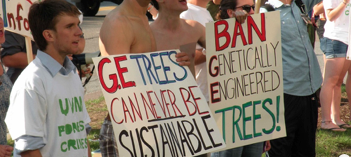
Note: As the Campaign to STOP Genetically Engineered (GE) Trees is gearing up to meet the GE trees industry head-on in Asheville, NC next week, Enviva just announced the opening of a new wood pellet facility in eastern North Carolina.  Industry hopes to supply these wood pellet facilities – which are designed to manufacture pellets bound for European markets – with GE trees like loblolly pine, eucalyptus and other species in the near future.  Please join us in Asheville next week, or follow updates from the protest on Climate Connections.  For more info, go to treebiotech2013.org

-The GJEP Team

May 21, 2013. Source: Bioenergy Insight

images

A new US wood pellet production facility owned by Enviva Pellets has been officially opened in North Carolina.

The facility has a capacity of 500,000 tonnes a year and is set to support 79 full time employees and an additional 130 jobs in forestry and logistic sectors.

The pellets will be exported through Enviva’s Port of Chesapeake export terminal in Virginia to European energy utility customers.

‘Global demand for biomass energy is projected to increase substantially over the next decade,’ says Enviva CEO John Keppler. ‘Our footprint in North Carolina plays an important role in meeting that demand and in delivering environmental and economic benefits both to our customers and to the region’s related industries.’

1 Comment

Filed under Climate Change

Crews search for survivors of deadly Oklahoma tornado

Note: One more mega-storm in the era of extreme weather.

-The GJEP Team

By John Eligon and and Michael Schwirtz, May 21, 2013. Source: NY Times

Photo: Nick Oxford for the New York Times

Photo: Nick Oxford for the New York Times

Emergency crews and volunteers continued to work through the early morning hours Tuesday in a frantic search for survivors of a huge tornado that ripped through parts of Oklahoma City and its suburbs, killing at least 91 people, 20 of them children, and flattening whatever was in its path, including a hospital and at least two schools.

Much of the tornado damage appeared to be in the suburb of Moore, where rescue workers struggled to make their way through debris-clogged streets and around downed power lines to those who are feared trapped under mountains of rubble.

The risk of tornadoes throughout the region remained high Tuesday, according to the National Oceanic and Atmospheric Administration’s Storm Prediction Center in Norman.

Amy Elliott, the spokeswoman for the Oklahoma City medical examiner, said at least 91 people had died, and officials said that toll was likely to climb. Hospitals reported at least 145 people injured, 70 of them children.

Continue reading

Leave a Comment

Filed under Climate Change, Ending the Era of Extreme Energy, Natural Disasters

Obama’s Arctic strategy sets off a climate time bomb

17 May 2013. Source: The Guardian

US National Strategy for the Arctic Region prioritises corporate ‘economic opportunities’ at the expense of everyone else

Sheel oil Arctic drilling rig Kulluk aground on the southeast shore of Sitkalidak Island

Shell’s drilling rig Kulluk aground on the southeast shore of Sitkalidak Island about 40 miles southwest of Kodiak City, Alaska, January 4, 2013. Photograph: Zachary Painter/USCG


One week ago, the Obama administration launched its National Strategy for the Arctic Region, outlining the government’s strategic priorities over the next 10 years. The release of the strategy came about a week after the Office of Science and Technology Policy within the Executive Office of the President at the White House Complex hosteda briefing with international Arctic scientists.

Despite giving lip service to the values of environmental conservation, the new document focuses on how the US can manage the exploitation of the region’s vast untapped oil, gas and mineral resources in cooperation with other Arctic powers.

US hinges success of Arctic strategy on diminishing sea ice

At the heart of the White House’s new Arctic strategy is an elementary but devastating contradiction between what President Obama, in the document’s preamble, describes as seeking “to make the most of the emerging economic opportunities in the region” due to the rapid loss of Arctic summer sea ice, and recognising “the need to protect and conserve this unique, valuable, and changing environment.” Continue reading

Leave a Comment

Filed under Climate Change, Climate Justice, Oceans, Oil, Politics, Pollution, The Greed Economy and the Future of Forests

Action Alert: Protect Papua New Guinea indigenous cave-dwellers from rainforest destroying mafia

May 20, 2013. Source: The Rainforest Portal  

meakambut-man_medNotorious Malaysian illegal loggers Rimbunan Hijau have diversified into mining in primary rainforests, in East Sepik threatening unique nomadic cave-dwellers and their 20,000 year old ancient stenciled cave art. Support the local resistance and demand an end to indigenous genocide and rainforest ecocide in the name of false development that is little more than pillaging and plundering of cultural and biological diversity.

TAKE ACTION: 

http://www.rainforestportal.org/shared/alerts/sendsm.aspx?id=PNG_indigenous

1 Comment

Filed under Actions / Protest, Forests, Illegal logging, Indigenous Peoples, Land Grabs

Action Alert: Indigenous peasant leader arrested in Guatemala – act now to stop his torture

May 20, 2013

The Guatemala Solidarity Project strongly condemns the arrest of our good friend Alberto Choc Xe, a community leader from the indigenous q’eqchi’ village Saquimo Setana.  Choc was arrested on Thursday, May 16.

We call on immediate solidarity from the international community.  We know that other arrested leaders of Saquimo Setana have faced beatings, hunger, false bribes and other forms of abuse and tricks used to pressure them to admit to crimes they didn’t commit and to implicate other local and national leaders in these crimes.

For background on the conflict in Saquimo Setana please refer to our earlier videos, two of which can be found at http://www.youtube.com/watch?v=IXoFw87lw0Y (an overview of the conflict at Saquimo) and http://www.youtube.com/watch?v=FN1pbixFMkc (which focuses on the case of another political prisoner from Saquimo).

We fear for Alberto’s immediate safety and we believe that the small action of calling the Guatemalan Consulate in Chicago can help protect Alberto in the coming hours and days.  Please call them at 312-540-0781 or 312-540-0808 to voice your extreme concern for the safety of Alberto Choc Xe of Saquimo Setana, arrested on May 16 in Canguanic, part of Coban, Alta Verapaz, and currently being held in Coban.  Please ask for the immediate release of Alberto, as well as of Pablo Sacrab,   another leader from Saquimo who has been in prison since 2010.

Please also consider making a contribution to the GSP.  All contributions go to our partners in Guatemala. Because of a budget shortfall we are not currently able to provide financial assistance to arrested Saquimo leaders.  In the past we have been able to help purchase medical supplies, food and other important support. Contributions can be made tax deductible through our fiscal sponsor UPAVIM by writing a check to the “UPAVIM Community Development Foundation” and sending to UPAVIM, c/o Greg Norman, 713 W. Garfield, Temple, TX, 76501.  Or donate on paypal at http://upavim.pursuantgroup.net/english/donate.htm (Click on “Make a Donation,” then write GSP in the description space)

1 Comment

Filed under Actions / Protest, BREAKING NEWS, Climate Change, Indigenous Peoples, Land Grabs, Latin America-Caribbean, Political Repression