
This piece examines the history of the takeover of the UN Climate Conferences by industry and promotes the US climate movement getting on board with the fundamental demands and actions, and alternative solutions being advanced by social movements around the world. It also gives a nod to the work of GJEP in this arena and credits our report, The Green Shock Doctrine. Thanks Margaret and Kevin!
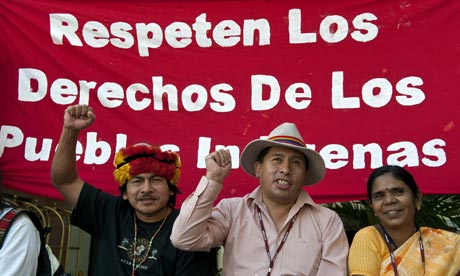
- Protest at UN Climate Conference, Cancun, Mexico 2010. Photolangelle.org
Climate Alarm Bells Ring but UN and Obama Administration Fail To Act
By Kevin Zeese and Margaret Flowers. The Smirking Chimp. September 5, 2014.The recent report by the Intergovernmental Panel on Climate Change (IPCC) is the most worrisome so far. Paired with data from the 2014 National Climate Assessment, there is no question that the climate crisis is here and is accelerating at a faster pace than predicted. Its effects are widespread and dangerous, yet real solutions are being suppressed.
The climate crisis is a ticking clock that demands immediate effective action, but the United Nations Conference of Parties (COP), which is the international body responsible for creating agreements on climate change, has become nothing more than a tool for multinational corporations and financiers to force a neo-liberal agenda and profit from the crisis. The false solutions being promoted displace and exploit people, destroy the environment and worsen climate change.
The climate crisis is our greatest challenge. Significant work has been done over the past decade by civil society groups around the world cooperating to create plans for resistance to the corrupt COP process and a vision for a just transition to sustainable systems. Now is the time for organizations throughout the United States that advocate for justice to recognize that the climate crisis affects all of us and to participate in this global movement.
Effective strategy requires knowledge of the political environment, the entities involved and an understanding of real versus false solutions. The United Nations, the United States government, Big Green Non-Governmental Organizations (NGOs) and the corporations that exert influence over them all are obstacles to effective action. Solutions exist but they won’t be coming from above, rather they will come from a mobilized grass roots demanding transformation to a carbon-free, nuclear-free energy economy.


